

On 22 August, Indian Prime Minister Moody signed the Cyber Games Promotion and Regulation Act 2025, marking a dramatic change in the digital landscape in India. In addition to strong legislative support for the development of the electric competition industry, the bill focuses on combating the real-gold gaming industry.
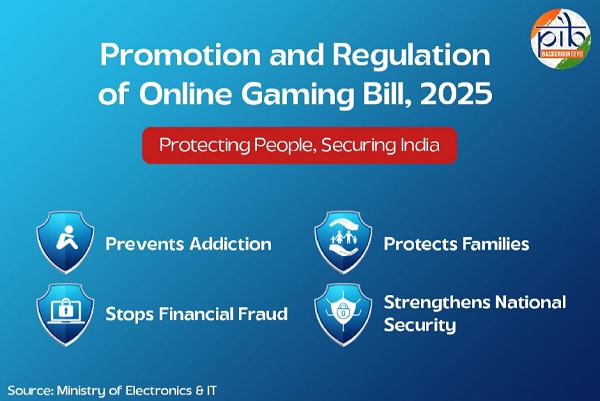
In less than three days, the bill has passed all reviews by the Federal Cabinet, the Wolesi Jirga and the House of Federation into legal regulations. Now, the bill prohibiting gold games throughout India is in force, leaving only a paper from the Ministry of Electronics and Information Technology of India. According to the Government of India, Internet games are destroying Indian families and have become a security threat.
India ‘ s genuine gold game industry, covering such popular platforms as Dream11, MPL, Zupee, Paytm First Games, Gates 24×7, Junglee Gomes and Adda52, was once the cornerstone of the country ‘ s digital economy. The industry, valued at Rs. 300 billion (approximately US$ 3.7 billion), supported some 200,000 to 300,000 direct and indirect jobs, covering various areas such as game development, platform management, customer support, marketing and data analysis. In addition to direct employment, the industry supports millions of professional players who earn their living through skills games, like stock market traders.

India ‘ s high mobile penetration and data flows have contributed to the growth of the industry, making it the world ‘ s largest game market, with 568 million users, or one fifth of the total number of online players worldwide, contributing 85.7 per cent of the industry ‘ s income in 2024 to the gold game alone. With the new legislation prohibiting all money-based online games, major related companies were forced to shut down the gold game almost overnight, resulting in thousands of employees.
In an interview with India Today, Saytm First Game, marketing expert at Paytm First Game, one of India ‘ s largest gold game companies, spoke about the attitude of the Indian Government to react quickly. He said: “There is no one to work. The staff were gathered to discuss the next plan, which was probably the worst feeling in their careers. The situation was that everything you built would collapse within hours without any warning.”
For nearly 300,000 practitioners in the industry, the ban is tantamount to a “floating disaster”. Many of these people, who depend on it to support their families, repay their mortgages and car loans, and take care of their elderly parents, are now faced with the difficult task of finding work in an industry that no longer exists. The Government acted so quickly that little time was left for companies and employees to prepare.

Industry estimates that the bill affects not only the internal team of large companies such as Dream11 and PokerBaazi, but also the contract workers of small companies that rely on the support of their outsourced clients. The ripple effect will extend to content creators and advertising, with an expected loss of income of about Rs. 170 billion (approximately $1.94 billion).
The advertising industry, particularly cricket, is facing major shocks. Platforms such as Dream11 and My11Circle have been the main sponsors, Dream11 has been awarded the Indian cricket team a title for about Rs. 3.58 billion and My11Circle a five-year IPL copyright for Rs. 6.25 billion. According to sports lawyer Vidushpat Singhania, the ban may reduce the personal sponsorship market for cricket players and the participation of fans in fantasy sports.
The Minister of Electronics and Information Technology of India, Ashwini Vashner, stated that the ban was a crucial step in addressing the social and economic harm caused by the gold game. The algorithms of these games are designed to lure players with small initial bonuses, which then result in huge losses, eventually leading to addiction to players and, in extreme cases, even economic collapse and suicide. “450 million people were negatively affected by the net gold game and thus faced losses of more than Rs. 200 billion”, he stressed in his interview.
In its statement, the Press and Information Agency (PIB) of the Government of India stated that the Internet gaming platform had caused widespread harm. The statement states: “Many families have broken up as a result, young people have become addicted to drugs, and some cases have even led to tragic consequences of suicide”.
The legislation not only prohibits the operation of the genuine gold game platform, but also prohibits its related advertising and financial transactions, with penalties of up to three years ‘ imprisonment and a fine of Rs. 10 million, and up to two years ‘ imprisonment or a fine of Rs. 5 million. Banks and financial institutions are prohibited from dealing with funds associated with these platforms, which effectively stifles their financial lifelines. The Government believes that these measures are essential to protect vulnerable groups, particularly youth and the economically disadvantaged, from cyberplay.
The Federal Minister of India, Vaishno, stated that the Government would “make every effort to support those affected”. However, as they did not provide specific measures, the practitioners remained frightened. “In India, unemployment is already high. If the Government had no specific plan, hundreds of thousands more would be unemployed, as a senior staff member of Dream11 in Mumbai said.
The senior manager of Junglee Games in Gurgon, Gauri Mittal, stated: “Some companies are trying to place affected professionals in other vertical areas, but this is the end of a company that focuses on the gold game.”

The genuine gold game industry and its supporters have strongly criticized the ban, arguing that it confuses fancy games such as sports, poker and Lame with gambling, ignoring the judicial distinction upheld by Indian courts. Industry associations such as the All India Lottery Federation (AIGF), the Electronic Games Federation (EGF) and the Indian FIFS have warned that the ban may “cause more than 200,000 jobs to be lost and more than 400 companies to collapse and undermine India’s position as a digital innovator”. In their view, skill-based games require tactics and expertise, similar to stock exchanges, and should not be subject to the same restrictions as speculative gambling.
Critics also warned that the ban might lead to the diversion of the lottery to underground grey areas. The Indian Lottery Federation (AIGF) warned that the ban could push tens of millions of legitimate players towards illegal gambling networks and unregulated offshore operators, increasing the risk of fraud, addiction and money-laundering.
India Today reported that an practitioner claimed that the Government’s practice was “misleading” and could violate the rights conferred by law. The industry also highlighted the irony of banning skill-type games while allowing high-risk futures and options (F&O) transactions. According to a report by the Securities and Exchange Commission of India in 2024, more than 93 per cent of the bulk traders lost an average of Rs. 200,000 per person over three years.
According to the data, the real gold game industry in India contributes more than Rs. 250 billion annually, including Rs. 200 billion in goods and services tax (GST) and income tax. Industry estimates that offshore lottery operators have caused over $4 billion in tax losses on goods and services to the Government and that this number may continue to grow as players move to unregulated platforms in grey areas. Ananay Jain, a partner in Grant Thornton Bharat, warned that the legislation “has the potential to destroy one of India’s fastest-growing ecosystems” and could lead to a shift in investment to more liberal jurisdictions.

While the ban heralds the end of the gold game, the Online Games Act provides a life for electronic games and non-monetary social games. The Act formally recognizes electronic competition as competitive sport, and the Ministry of Youth Affairs and Sports is responsible for establishing training colleges, research centres and incentive schemes. This initiative was praised by industry leaders such as the NODWIN Gaming company Akshat Rathee, and enabled India to take advantage of the flourishing of the global electronics competition, especially in the light of the fact that the electronics competition will be the first visible Olympics in 2027. Education and social play, which focus on entertainment and skills development without any economic benefits, will also receive government support, in line with India’s ambitious goal of becoming a “global centre for the development of creative and innovative games”.