

The regulatory system for the online game industry in India has been completed and the rules have been brought into force in conjunction with the Online Game Promotion and Regulation Act on 1 May. The system includes a central regulator and provides for classification and regulatory provisions for various types of online games. The Indian Online Lottery Regulatory Rules, published on 22 April 2026, came into effect on 1 May and together with the Online Game Promotion and Regulation Act, established a formal system that distinguishes online gold and electronic games from social games. The new framework is intended to provide legal definitions, registration rules and enforcement mechanisms for the industry.

Under the new system, games will be evaluated through objective and time-bound tests. The rule defines an “online gold game” as a game where the user pays fees or bets and has a reasonable expectation of a financial return, and such games are prohibited. Social games and electronic games, which are permitted by law, need to be conducted in compliance with specific safeguards. The online game authority will have the authority to issue licences and authorizations under the framework. In deciding how to classify the game, the regulator will take into account a number of factors, including the nature of costs and bets, the expected benefits, the pattern of the game ‘ s profitability, and how the rewards or the assets of the game will be realized outside the game. The classification decision must be made within 90 days of receipt of the full application or notification. This time frame is intended to provide the industry with a clearer process to determine which products can operate under the legal framework. The core of the new regulatory system is the Indian Online Games Authority (OGAI), which operates as a subsidiary body of the Indian Ministry of Electronics and Information Technology, with its headquarters in the Delhi district. OGAI is a streamlined multisectoral body chaired by the Deputy Minister of Electronic Information Technology, with the participation of deputy ministerial representatives from other ministries. The aim is to maintain an official list of online gold games, including those considered harmful because of financial and social risks, to issue directives, to process queries and to develop codes of conduct. OGAI will also receive users ‘ appeals against Platform complaints decisions and work in coordination with financial regulators. The new architecture is intended to provide the Government with a central body to centralize the entire online game industry.
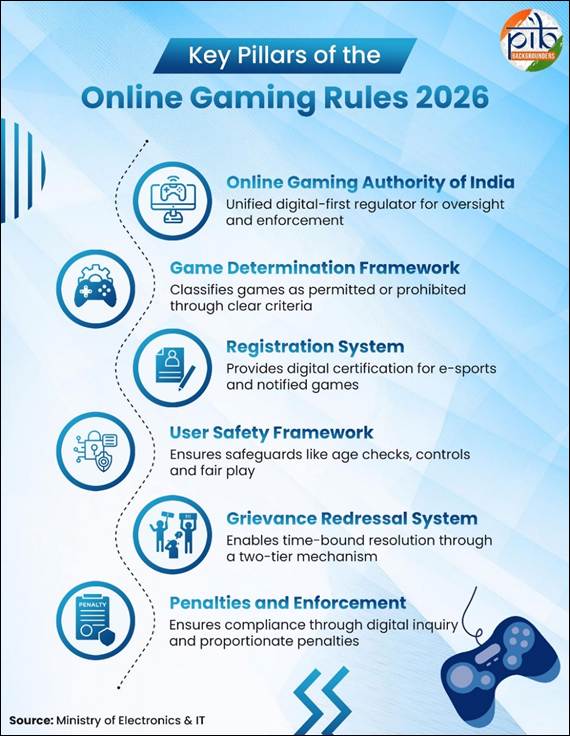
According to the Framework, only games or categories designated by the central Government need to be registered, including those that are assessed on the basis of the risks to users (especially minors), size, financial transactions and origin. Registration is also required for all games that are expected to be recognized by electronic competitions. The registered provider will receive a digital registration certificate with a maximum validity of 10 years. According to the National Sports Governance Act of India,The online gold game shall not be recognized for any electronic competition.Game platforms must enforce mandatory safety provisions, such as age verification, time limits, parental control systems, application feedback systems, counselling and anti-fraud systems that safeguard game fairness. These security provisions and complaint-handling mechanisms should be disclosed during the registration process. The new system also includes a two-tier complaints system. Users dissatisfied with the Platform’s response will have 30 days to file a complaint with the operator and then appeal to OGAI, which will seek to resolve the matter within 30 days. Users can also file further appeals to the Minister of Electronic Information Technology, with a target resolution time of 30 days. Cases will be dealt with digitally, with the aim of resolving them within 90 days of the complaint being filed. The severity of the penalty will depend on such factors as the proceeds of the offence, the influence of the user, the situation of recidivism, the severity of the offence and the resources spent to deal with the problem.
The Act also aims to prevent regulated financial institutions and payment systems from dealing with any transactions related to illegal online games. This will require close cooperation between OGAI and financial regulators and will have an impact on the application of in-service payments, monetization techniques and liquidity channels.